
CVD vs. HPHT Lab-Grown Diamonds: A Complete Quality Comparison
Both CVD and HPHT diamonds are real diamonds. That is not a marketing claim — it is a scientific fact confirmed by gemological laboratories worldwide. They share the same carbon crystal structure, the same optical properties, and the same physical hardness as diamonds formed deep within the Earth over billions of years. The difference between them is not a question of authenticity. It is a question of how they were grown, and how that growth process influences the characteristics of the finished stone.
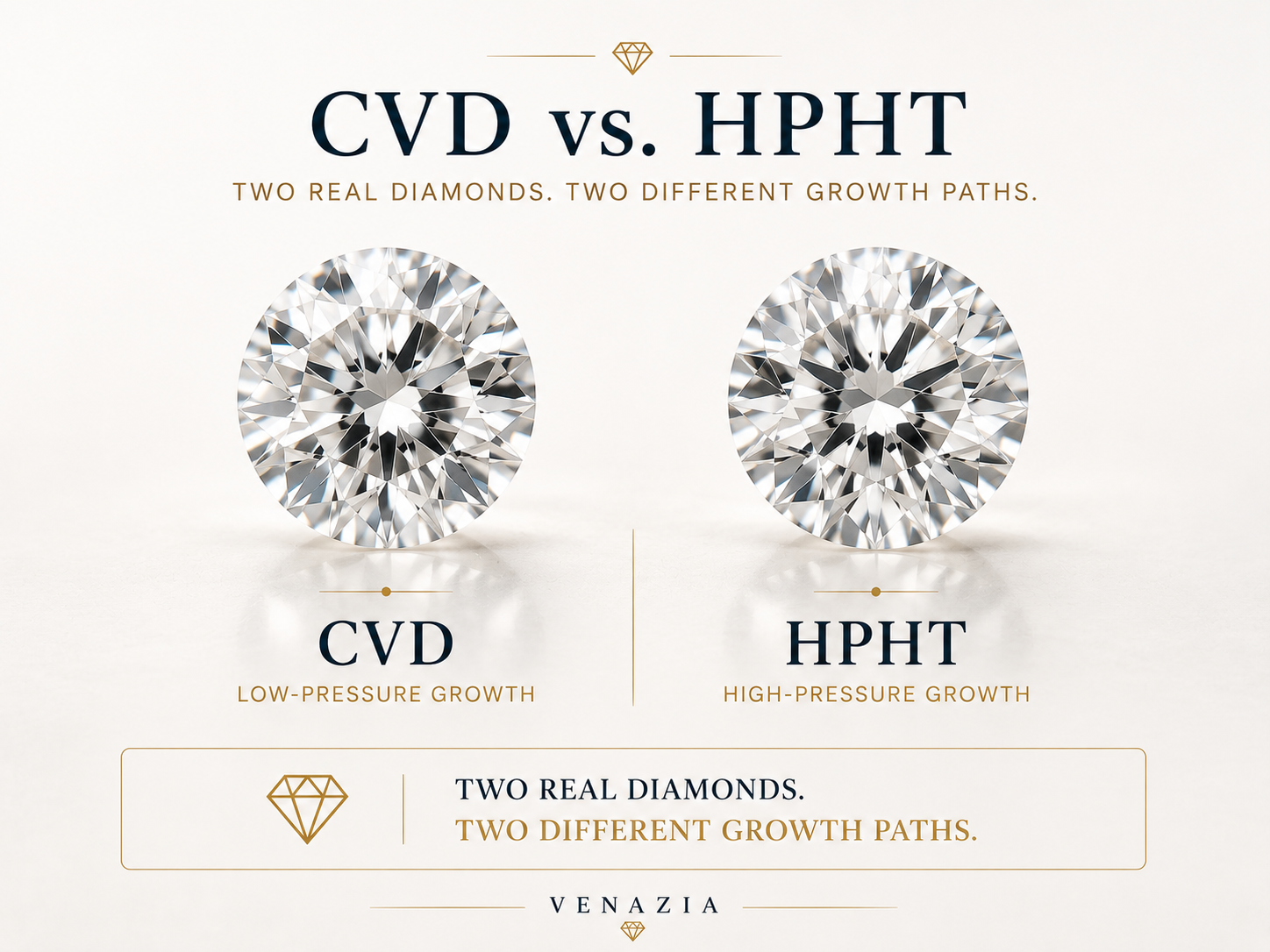
Understanding that distinction — clearly, practically, without unnecessary complexity — is what this article is designed to deliver.
How Each Process Actually Works
High pressure high temperature growth, known as HPHT, is the older of the two methods. It was first used to produce gem-quality diamonds in the 1950s and takes its name from the conditions it replicates: the extreme heat and pressure found deep within the Earth where natural diamonds form. In an HPHT reactor, a small diamond seed crystal is placed in a growth chamber alongside a carbon source, typically graphite. The chamber is then subjected to temperatures of approximately 2,000 degrees Celsius and pressures exceeding 1.5 million pounds per square inch. Under those conditions, the carbon dissolves and crystallizes onto the seed, growing a larger diamond over a period of days to weeks.
Chemical vapor deposition, or CVD, is a newer technology that takes a fundamentally different approach. Instead of replicating the pressure of the deep Earth, CVD grows diamonds in a low-pressure vacuum chamber. A thin diamond seed wafer is placed inside the chamber, which is then filled with a carbon-rich gas — typically methane — and energized by a microwave or other energy source. The energy breaks the gas molecules apart, freeing carbon atoms that then deposit onto the seed crystal layer by layer, building the diamond upward like a very precise form of atomic construction. CVD growth typically takes several weeks per stone.
Both methods produce diamonds that are physically, chemically, and optically identical to mined diamonds. Neither process creates a simulant or an imitation. What they create are genuine diamonds that differ from each other — and from mined stones — only in the specific internal features their respective growth environments produce.
How Growth Method Affects Color
Color is one of the most buyer-relevant areas where CVD and HPHT diverge in meaningful ways.
HPHT diamonds can grow across a wide color range, but the process has historically been associated with the production of fancy colored diamonds, particularly yellows and blues, because the growth environment can incorporate nitrogen or boron into the crystal structure. For colorless and near-colorless stones in the D-to-J range that most engagement ring buyers seek, HPHT diamonds are widely available and can achieve excellent color grades. However, some HPHT stones exhibit a slight yellow or brownish tint tied to nitrogen incorporation during growth, which is why post-growth treatment — including HPHT treatment itself applied to already-grown stones — is sometimes used to improve color.
CVD diamonds have a different color profile. Because the CVD process occurs at lower pressure and in a more controlled gas environment, it tends to produce stones that are naturally inclined toward the colorless range. However, CVD diamonds can sometimes exhibit a slight grayish or brownish tint caused by structural defects introduced during layer-by-layer growth. These stones are often subjected to post-growth HPHT treatment to correct the color, which is a standard and disclosed industry practice. The result is a CVD diamond that has been color-optimized and grades in the colorless or near-colorless range.
For buyers targeting D, E, or F color grades, both processes can deliver. The key is to evaluate the actual color grade on the grading report rather than assuming either process guarantees a specific outcome.
How Growth Method Affects Clarity
Clarity differences between CVD and HPHT diamonds are real but often overstated in popular content.
HPHT diamonds can contain metallic inclusions — tiny traces of the metal flux used in the growth process — that are occasionally visible under magnification. These inclusions are distinctive enough that trained gemologists can sometimes use them to identify HPHT origin. They are typically not visible to the naked eye in stones graded SI1 or better, but they are a characteristic feature of the process worth knowing about.
CVD diamonds tend to have a different inclusion profile. The layer-by-layer growth can introduce pinpoint inclusions, clouds, or graining patterns associated with the deposition process. In well-controlled CVD growth, high clarity grades — VS2, VS1, and above — are achievable and common. Some sources suggest that CVD growth allows for more precise control over the growth environment, which can translate to more consistent clarity outcomes at scale, though the quality of any individual stone still depends on the specific growth run and post-growth processing.
Neither process is inherently superior for clarity. Both can produce eye-clean stones at VS2 and above. Both can also produce stones with visible inclusions if growth conditions are suboptimal. The grading report is the definitive guide — not the process name.
Size, Shape, and Market Availability
CVD has become the dominant production method for larger, gem-quality lab-grown diamonds, particularly in the one-carat-and-above range that most engagement ring buyers are targeting. The CVD process is well-suited to growing larger crystals with consistent quality, and the technology has scaled rapidly over the past decade. Microwave plasma CVD reactors, which represent a significant share of current production capacity, have enabled producers to grow larger stones with greater control over the growth environment.
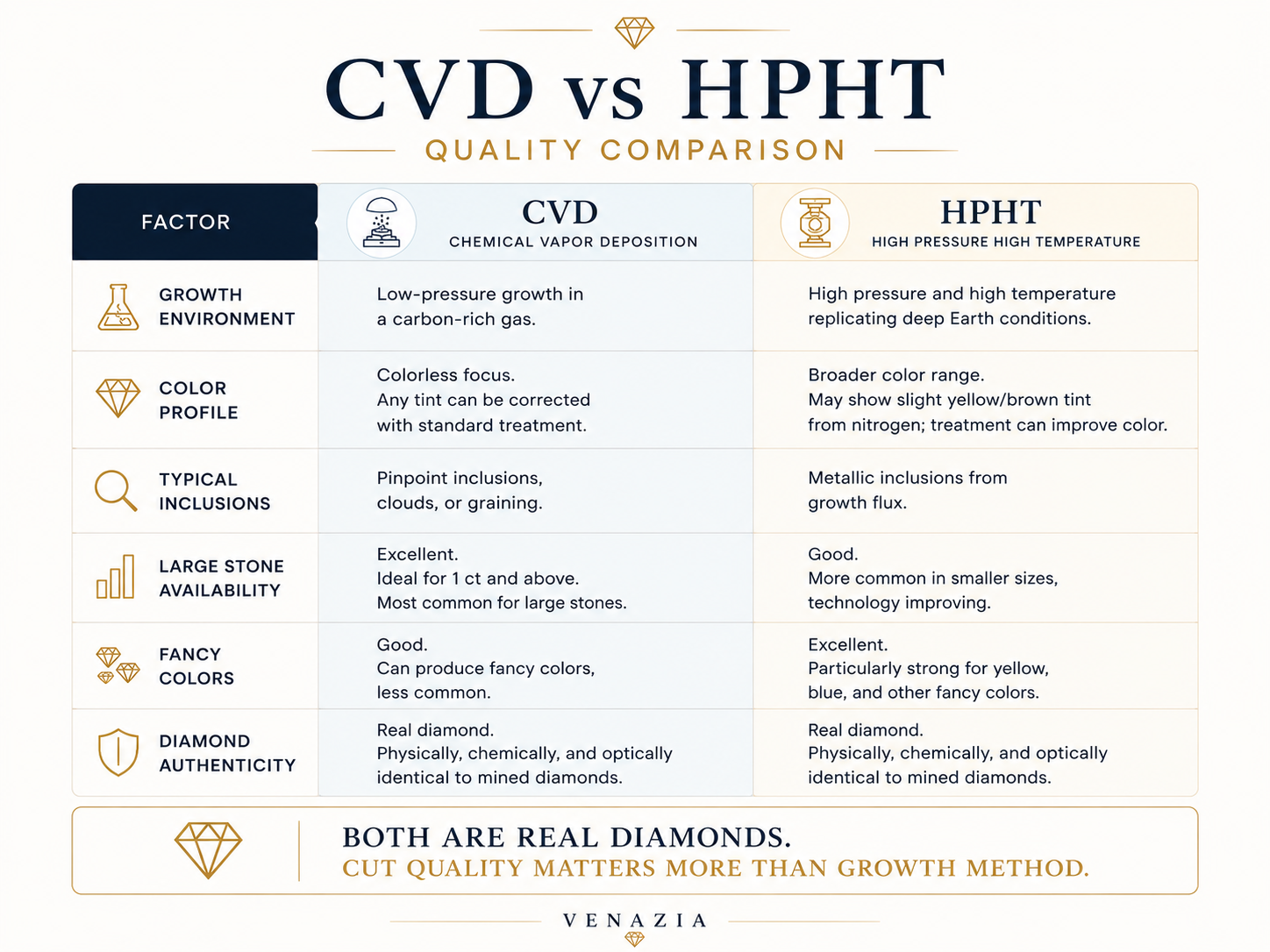
HPHT production remains significant, particularly for smaller stones and for the production of fancy colored diamonds. HPHT is also the process used for post-growth color treatment of both HPHT and CVD diamonds, which means the two methods are sometimes used in combination rather than as strict alternatives.
For buyers shopping in the one-carat-plus range for round, oval, cushion, or other popular engagement ring shapes, CVD stones will represent the majority of available inventory at most retailers. HPHT stones are available but may be less prevalent in larger sizes at the colorless end of the spectrum.
Price Differences Between CVD and HPHT
Price differences between CVD and HPHT diamonds of equivalent quality are not dramatic, and they vary by retailer, size, and quality tier. As a general pattern, CVD diamonds have become increasingly cost-competitive as production technology has scaled, and they are often positioned at accessible price points relative to equivalent mined diamonds. HPHT diamonds can sometimes carry a slight premium in certain quality tiers, though this is not a universal rule.
The more important price variable for buyers is the combination of carat weight, cut, color, and clarity — the four factors that drive the vast majority of price variation between individual stones. Two diamonds of the same process, same carat weight, and same color grade can vary significantly in price based on cut quality and clarity grade. Focusing on process as a price driver is less useful than understanding how the 4Cs interact to determine value.
What Grading Reports Say About Growth Method
Grading reports from major gemological laboratories — including GIA, IGI, and GCAL — disclose the growth method for lab-grown diamonds. This information typically appears in the additional information or comments section of the report, where the stone will be identified as laboratory-grown and the growth method — CVD or HPHT — will be noted. Some reports also note whether post-growth treatment has been applied.
This disclosure is important for transparency and is a standard part of responsible lab-grown diamond commerce. Buyers should always request and review the grading report for any lab-grown diamond they are considering. The report confirms not only the growth method but the independently verified grades for cut, color, clarity, and carat weight — the variables that actually determine the stone’s appearance and value.
One practical note: the presence of a growth method disclosure on a grading report is not a negative. It is a sign of transparency. A lab-grown diamond with a full grading report from a reputable laboratory is a well-documented stone, regardless of whether it is CVD or HPHT.
The Variable That Matters Most: Cut Quality
If there is one insight that should anchor every lab-grown diamond purchase, it is this: cut quality is the single most important determinant of how a diamond looks in real life.
Cut determines how light enters a diamond, how it reflects internally, and how it returns to the eye as brilliance, fire, and scintillation. A diamond with an excellent or ideal cut grade will outperform a diamond with a good or very good cut at the same color and clarity level — regardless of whether it is CVD or HPHT, regardless of whether it is lab-grown or mined. The physics of light behavior in a diamond crystal are the same across all growth methods.
When evaluating lab-grown diamonds, prioritize cut grade above all other variables. Then consider color and clarity in the context of your budget and visual preferences. The growth method is a secondary consideration — useful context, but not the deciding factor for most buyers.
CVD or HPHT: A Practical Summary
For buyers who want a direct answer: CVD diamonds are generally the better choice for shoppers prioritizing broad availability, consistent colorless grades, and value in the one-carat-plus range. The technology is mature, production is scaled, and the market offers a wide selection of well-graded CVD stones across popular shapes and sizes.
HPHT diamonds are a strong choice for buyers who want a process that more directly replicates natural diamond formation conditions, or who are interested in fancy colored stones where HPHT has particular strengths. For colorless engagement ring diamonds, HPHT stones are fully competitive when the grading report shows strong 4C grades.
In both cases, the right stone is the one with the strongest combination of cut, color, clarity, and certification — evaluated on its own merits, not on the reputation of its growth method.
Frequently Asked Questions
What is the main difference between CVD and HPHT lab-grown diamonds?
CVD grows diamonds layer by layer in a low-pressure gas chamber, while HPHT replicates the extreme heat and pressure of the Earth’s mantle. Both produce genuine diamonds, but their growth environments create different internal characteristics.
Do CVD diamonds have better color than HPHT diamonds?
CVD diamonds tend to be naturally inclined toward the colorless range but can exhibit a grayish tint corrected by post-growth treatment. HPHT diamonds can achieve excellent colorless grades but may show nitrogen-related tints. Both processes can deliver D–G color grades.
Are there clarity differences between CVD and HPHT diamonds?
HPHT diamonds can contain distinctive metallic inclusions from the growth flux, while CVD diamonds may show pinpoint inclusions or graining from layer-by-layer deposition. Both processes can produce eye-clean stones at VS2 and above.
Is one process cheaper than the other?
Price differences between CVD and HPHT diamonds of equivalent quality are not dramatic. The 4Cs — cut, color, clarity, and carat weight — drive far more price variation than the growth method alone.
Do grading reports disclose whether a diamond is CVD or HPHT?
Yes — GIA, IGI, and GCAL all disclose the growth method on lab-grown diamond reports, along with any post-growth treatment. This transparency is standard practice and a sign of a well-documented stone.


