
How to Buy a Lab-Grown Diamond Using the 4Cs: Venazia’s Practical Buying Guide
You’ve done the research. You understand that lab-grown diamonds are graded on the same 4Cs as natural diamonds, certified by the same independent laboratories, and priced at a fraction of the cost for equivalent quality. Now comes the actual decision: which grades do you choose, and how do you make sure you’re getting a diamond that looks as good as its certificate says it should?
This guide gives you Venazia’s direct recommendations — specific grade ranges, prioritization frameworks, and a confidence checklist — so you can buy without second-guessing yourself.
Venazia’s Non-Negotiable: Cut Grade First, Always
Before any other consideration, Venazia recommends Excellent cut only for round brilliant lab-grown center stones. This is not a preference — it is a standard. A round brilliant with a Very Good cut grade can still be a beautiful diamond, but when you are buying a lab-grown stone and the price premium for Excellent over Very Good is modest, there is no rational reason to accept less than the best light performance available.
For fancy shapes — oval, cushion, pear, emerald, radiant — cut grades are less standardized across labs, so the overall cut grade is less definitive. For these shapes, Venazia evaluates polish and symmetry (both should be Excellent or Very Good), reviews the stone’s proportions, and assesses performance through video. If you are considering a fancy shape, book a consultation with the Venazia team to review specific stones before committing.
The rule that never changes: do not trade cut quality for carat weight. A larger, poorly cut diamond is a worse diamond. Full stop.
Color Recommendations by Metal Setting
Color is where your metal choice does the most work. Here are Venazia’s recommended color ranges by setting:
- Platinum or 18k white gold: D–H. For the crispest, most colorless appearance in a cool metal, F or G is the sweet spot — genuinely colorless face-up without the premium of D or E. H is acceptable and will appear white to nearly all observers.
- 14k white gold: F–I. The slightly warmer alloy composition of 14k white gold (compared to 18k or platinum) provides a small buffer. G–H is ideal.
- 14k or 18k yellow gold: H–J. Warm metal tones neutralize any faint warmth in the diamond beautifully. An H or I color lab-grown diamond in a yellow gold solitaire will appear bright white face-up. The savings on color can go directly toward carat weight.
- Rose gold: H–J. Similar logic to yellow gold. The warm pink tone of rose gold is highly forgiving of slight diamond warmth.
Is D or E color worth it for lab-grown? Only if colorlessness is a personal specification that matters to you. The visible difference between D and F is imperceptible in normal viewing conditions. Venazia does not recommend paying the D/E premium unless you have a specific reason to do so.
Clarity: Target Eye-Clean, Not Flawless
Venazia’s recommended clarity range for lab-grown center stones is VS2 to SI1, eye-clean verified. Here is what that means in practice:
- VS2: The vast majority of VS2 lab-grown diamonds are eye-clean. Inclusions are minor and not visible without magnification. This is an excellent value grade — you get a stone that looks flawless to the naked eye without paying for VVS or IF.
- SI1: Many SI1 stones are eye-clean, but this requires verification of the specific stone. Venazia reviews SI1 stones individually and can confirm eye-cleanliness. Do not buy an SI1 without seeing a high-quality video of the actual stone or having a specialist confirm it.
- SI2 and below: Not recommended for center stones without careful individual review. The risk of visible inclusions is meaningful at this grade.
- VVS1, VVS2, IF, FL: Genuine quality achievements, but the inclusions they lack are invisible to the naked eye regardless. For lab-grown diamonds, where the price premium over VS2 is smaller than in natural diamonds, some buyers choose VVS as a personal preference. It is not a practical necessity.
Venazia only lists lab-grown diamonds certified by IGI or GIA. House certificates are not accepted. Every stone in the Venazia collection has an independent grading report with a verifiable report number.
Three Buying Profiles: Find Yours
Different buyers prioritize different outcomes. Here are three clear profiles with specific 4C targets:
Profile 1: The Sparkle-First Buyer
You want a diamond that blazes. Sparkle is the priority above all else.
- Cut: Excellent only. No exceptions.
- Color: F–G in white metal; H in yellow or rose gold.
- Clarity: VS1–VS2 eye-clean. Higher clarity supports maximum light return.
- Carat: Choose the largest stone your budget allows after locking in the above grades.
- If you need to reduce cost: Move clarity from VS1 to VS2, or color from F to G. Never reduce cut.
Browse round lab-grown engagement rings — the round brilliant is the cut grade most optimized for maximum sparkle.
Profile 2: The Big-Look Value Hunter
You want the most impressive-looking diamond for your budget. Size matters, but you won’t sacrifice a dead stone for a big one.
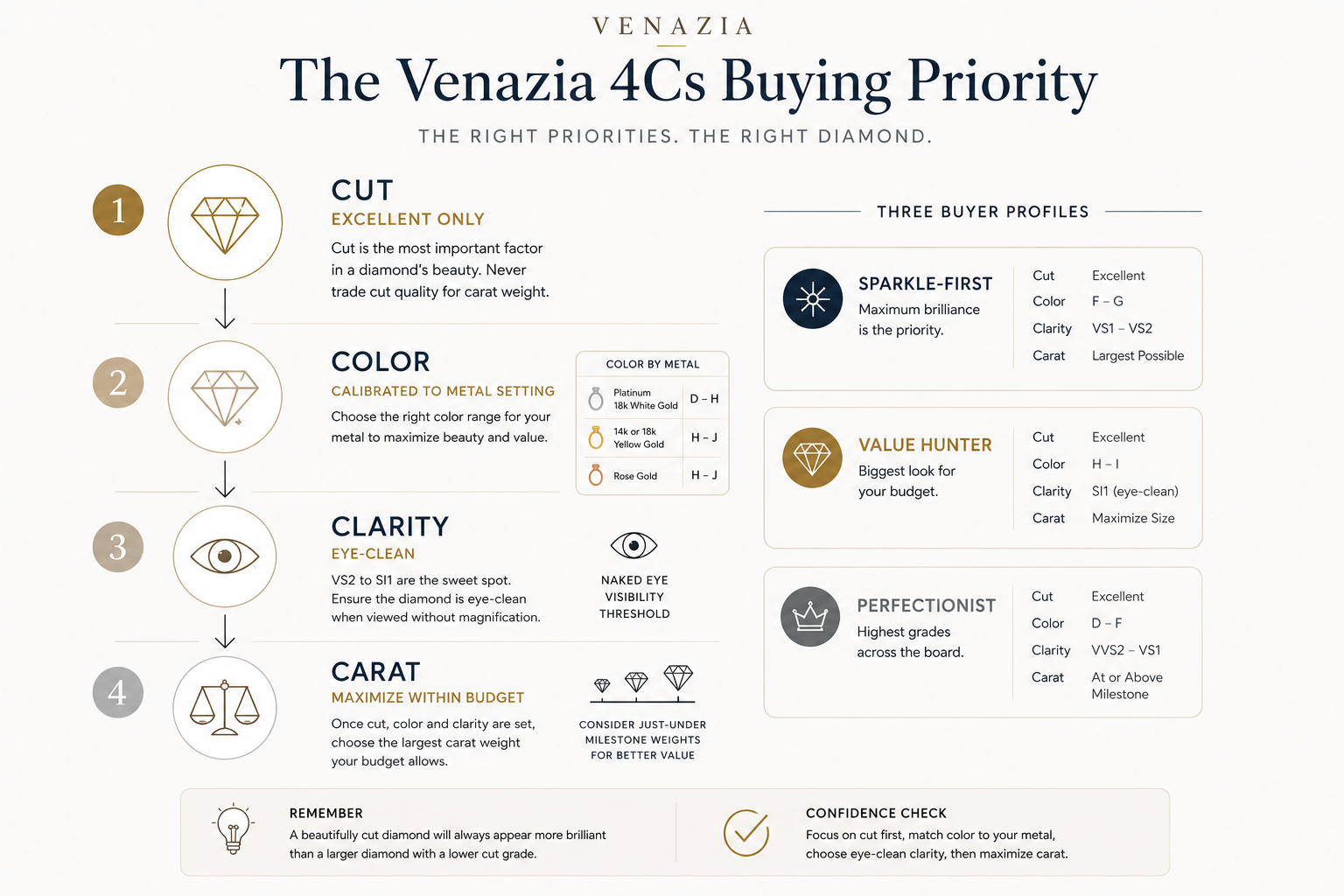
- Cut: Excellent. Still non-negotiable — a poorly cut large stone looks smaller than a well-cut smaller one.
- Color: H–I in white metal; I–J in yellow or rose gold.
- Clarity: SI1 eye-clean verified. This is where the savings come from.
- Carat: Maximize. Consider just-under milestone weights (0.90–0.99ct, 1.40–1.49ct, 1.90–1.99ct) for meaningful savings with no visible size difference.
- If you need to reduce cost: Move to J color in a warm metal setting, or confirm an SI1 eye-clean stone rather than VS2.
Explore lab-grown diamond solitaire rings — a clean solitaire setting maximizes the apparent size of the center stone.
Profile 3: The Perfectionist (High Specification)
You want the best grades across the board. Quality is the priority and budget is less constrained.
- Cut: Excellent, with Excellent polish and symmetry.
- Color: D–F in platinum or 18k white gold.
- Clarity: VVS2–VS1.
- Carat: Choose your target weight at or above the milestone (1.00ct, 1.50ct, 2.00ct).
- If you need to reduce cost: Move from VVS2 to VS1, or from E to F color. The visual difference is negligible.
View platinum lab-grown engagement rings — platinum is the ideal metal for showcasing top-color, high-specification lab-grown diamonds.
How the 4Cs Interact with Setting Style
Your setting choice affects which grades matter most:
- Halo settings: The surrounding halo of smaller diamonds amplifies apparent size, which means you can often choose a slightly smaller center stone and still achieve a dramatic look. Color consistency between the center stone and halo diamonds matters — Venazia matches halo stones to the center stone’s color grade. Browse lab-grown diamond halo rings.
- Three-stone settings: Side stones should complement the center stone in color and clarity. Venazia curates three-stone settings for visual harmony across all three stones. See lab-grown three-stone engagement rings.
- Solitaire settings: The center stone is fully exposed, so cut and color are most visible. This setting rewards the highest cut grade you can afford.
- Side-stone settings: Similar to three-stone in terms of color matching considerations. Explore lab-grown side-stone engagement rings.
Budget Examples: What Your Money Buys in Lab-Grown
These are representative configurations — actual availability varies, but these illustrate what is typically achievable with lab-grown diamonds at different price points:
- Around $1,500–$2,500: Excellent cut, G–H color, VS2 clarity, 0.70–0.90ct round brilliant. A genuinely beautiful, certified diamond that would cost significantly more in natural.
- Around $2,500–$4,000: Excellent cut, F–G color, VS1–VS2 clarity, 1.00–1.20ct round brilliant. A milestone carat weight with strong grades across all four Cs.
- Around $4,000–$6,500: Excellent cut, E–F color, VVS2–VS1 clarity, 1.50–1.80ct round brilliant. High-specification diamond at a size that would be a significant stretch in natural.
- $6,500 and above: Excellent cut, D–F color, VVS1–VVS2 clarity, 2.00ct and above. Exceptional stones that represent the top of what lab-grown offers — at prices that remain a fraction of natural equivalents.
To explore current availability across these ranges, visit Venazia’s lab-grown diamond engagement rings or book a consultation to have the team identify specific stones matching your criteria.
Your Confidence Checklist
Before you confirm any lab-grown diamond purchase, verify the following:
- Cut grade: Excellent (or Ideal) for round brilliants. Polish and symmetry both Excellent or Very Good.
- Color grade: Within the recommended range for your metal setting (see above).
- Clarity grade: VS2 or SI1, confirmed eye-clean through video or specialist review.
- Carat weight: Appropriate for your budget after locking in cut, color, and clarity. Consider just-under milestone weights for value.
- Certification: IGI or GIA grading report. Report number matches the laser inscription on the diamond’s girdle.
- “Laboratory-Grown” designation: Confirmed on the grading report.
- Fluorescence: None to Faint is ideal. Medium blue is generally acceptable. Very Strong fluorescence warrants individual review.
If your diamond meets all seven criteria, you can buy with confidence. If you are uncertain about any line on the grading report, or if you want a second opinion on a specific stone, contact Venazia directly. The team reviews grading reports and can tell you plainly whether a stone is a strong choice or whether a better option exists in the collection.
The goal is simple: a certified, beautifully cut lab-grown diamond that you will love every time it catches the light. That outcome is entirely achievable — and with the right grades in place, it is not a matter of luck. It is a matter of knowing what to look for.
Start with Venazia’s full lab-grown engagement ring collection, or go straight to a one-on-one consultation if you’d prefer to have a specialist walk you through the options for your specific budget and priorities.
Frequently Asked Questions
What is the best clarity grade for a lab-grown diamond engagement ring?
VS2 to SI1, eye-clean verified. The vast majority of VS2 lab-grown diamonds are eye-clean, and many SI1 stones are too — but SI1 requires individual verification through video or specialist review before purchase.
Should I buy a D color lab-grown diamond?
Only if colorlessness is a personal specification that matters to you. The visible difference between D and F is imperceptible in normal viewing conditions, and Venazia does not recommend paying the D or E premium unless you have a specific reason.
What color grade should I choose for a yellow gold engagement ring?
H–J color is ideal for yellow gold settings. The warm metal tone neutralizes any faint warmth in the diamond, so an H or I color lab-grown stone will appear bright white face-up — and the savings can go toward carat weight.
What does ‘just under milestone weight’ mean and why does it save money?
Diamonds at round-number carat weights (1.00ct, 1.50ct, 2.00ct) command a price premium due to demand. Stones just below those thresholds — 0.90–0.99ct or 1.40–1.49ct — are visually indistinguishable in size but typically priced meaningfully lower.
Explore
Does Venazia accept house certificates for lab-grown diamonds?
No. Venazia only lists lab-grown diamonds certified by IGI or GIA. House certificates issued by the retailer themselves are not independent verification and are not accepted for center stone purchases.


