
Lab-Grown Diamond Resale Value Explained: What the Numbers Actually Say
If you have spent any time researching lab-grown diamonds, you have almost certainly encountered the resale value question — usually framed as a warning. Lab-grown diamonds, the argument goes, lose their value faster and more completely than natural diamonds, making them a poor financial choice.
That framing contains some truth. But it also contains some significant omissions. This article walks through the actual data: what lab-grown diamonds typically resell for, how that compares to natural diamonds, why the gap exists, and what it means in practical terms for someone buying a ring today.
What Lab-Grown Diamonds Actually Resell For
The most widely cited range for lab-grown diamond resale value is ten to thirty percent of the original retail price. That means a lab-grown diamond purchased for two thousand dollars might realistically sell for somewhere between two hundred and six hundred dollars on the secondary market — and that assumes you find a willing buyer.
Some dealers will not purchase lab-grown stones at all, which means resale value in those scenarios is effectively zero. This is not universal, but it is common enough to factor into any honest assessment.
The reasons for this are structural, not arbitrary. Lab-grown diamonds are produced at scale using two primary methods — chemical vapour deposition and high-pressure high-temperature growth — and production capacity has expanded dramatically over the past decade. When supply is abundant and growing, secondary-market buyers have little incentive to pay a premium for a used stone when they can source a new, certified one at a competitive price.
How Natural Diamonds Compare on Resale
Natural diamonds fare better on the secondary market, but the gap is narrower than the industry narrative often implies. Depending on quality, size, documentation, and where you sell, natural diamonds typically resell for somewhere between twenty and sixty percent of their original retail price. A commonly cited rule of thumb puts the figure at around fifty percent, though many sellers — particularly those selling through pawn shops or general resellers rather than specialist diamond buyers — receive considerably less.
It is worth being direct about this: natural diamonds also lose a substantial portion of their retail value the moment they leave the store. The difference between lab-grown and natural on resale is real, but it is a difference of degree, not of kind. Neither is a liquid asset. Neither behaves like a financial investment in any conventional sense.
The Dollar Loss Comparison: Why Percentages Can Mislead
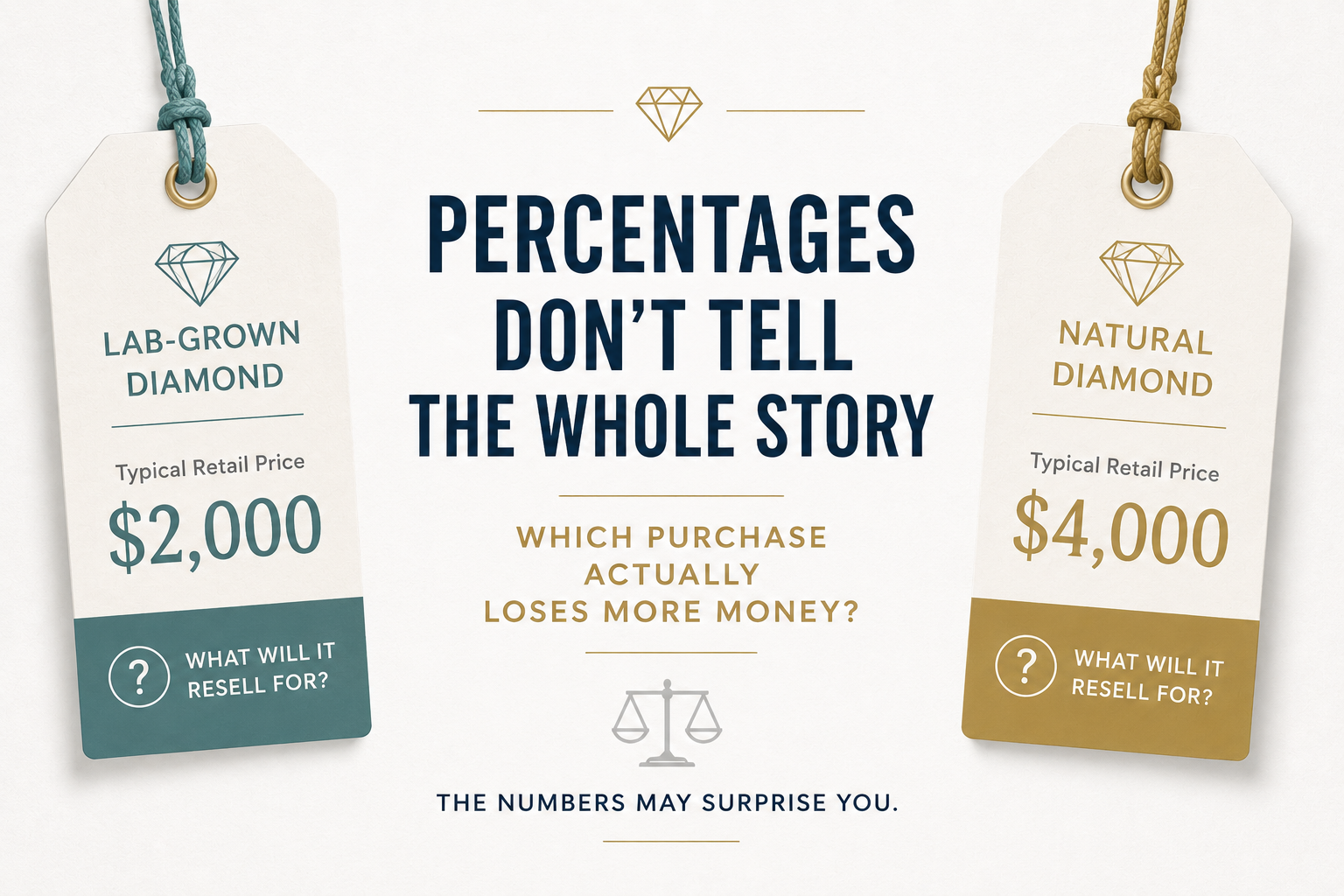
Percentage-based comparisons are useful, but they can obscure the more relevant question for most buyers: how much money, in absolute terms, am I likely to lose?
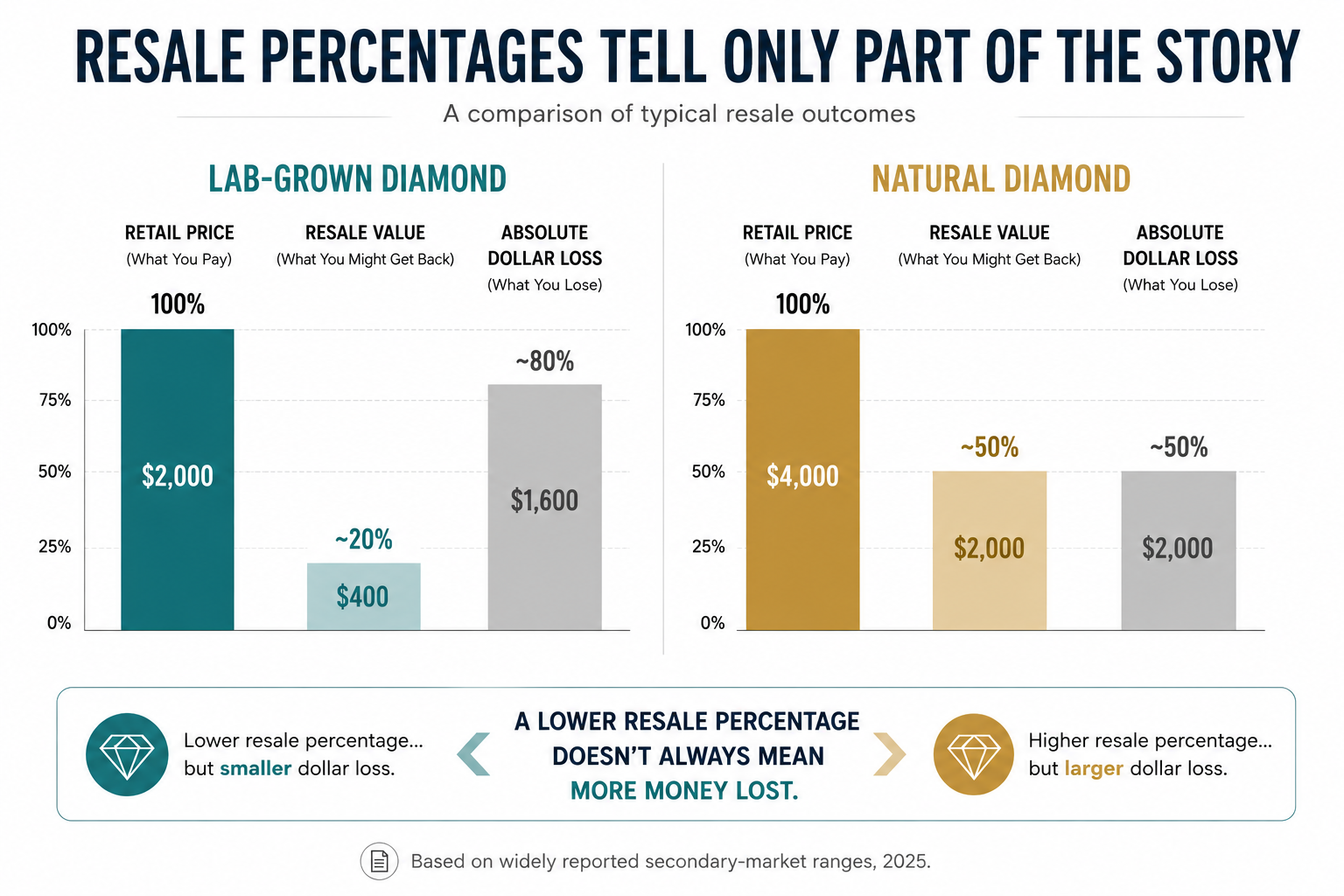
Consider two buyers with a budget of roughly four thousand dollars. One buys a one-carat natural diamond. The other uses the same budget to purchase a significantly larger or higher-quality lab-grown stone — perhaps a two-carat equivalent — for around two thousand dollars, and puts the remaining two thousand toward the setting or savings.
If the natural diamond resells at fifty percent, the seller recovers two thousand dollars and loses two thousand. If the lab-grown diamond resells at twenty percent, the seller recovers four hundred dollars and loses sixteen hundred. In this scenario, the lab-grown buyer actually loses less money in absolute terms, despite the lower resale percentage.
This arithmetic does not apply in every situation, and it depends heavily on how much of the budget goes toward the stone versus the setting. But it illustrates why percentage comparisons alone can be misleading when the underlying purchase prices differ by seventy to ninety percent.
Why Lab-Grown Diamond Prices Have Fallen So Sharply
To understand the resale picture, it helps to understand what has happened to lab-grown diamond prices over the past decade. The decline has been dramatic.
In 2016, a one-and-a-half carat lab-grown diamond sold for around ten thousand dollars. By 2021, the same stone was valued at roughly four thousand dollars. By early 2025, per-carat wholesale prices for lab-grown diamonds had fallen to levels that would have been unimaginable a decade earlier — with some estimates placing average per-carat prices below two hundred dollars at wholesale.
Industry data tracking wholesale prices has shown year-over-year declines of thirty percent or more at various points during this period, driven by expanding production capacity, improved growing technology, and increased competition from producers in India and China.
This price history has two important implications. First, buyers who purchased lab-grown diamonds between 2016 and 2020 at much higher prices have seen the most severe depreciation — not just relative to retail, but in absolute terms. Second, buyers purchasing today are entering at a price point that is already dramatically lower, which means the potential for further steep declines may be more limited, though not eliminated.
Whether lab-grown prices have reached a floor near production cost — or whether further declines are possible — remains genuinely uncertain. What is clear is that the trajectory of the past decade has been the primary driver of poor resale outcomes for early adopters.
Does Certification Affect Resale Value?
Yes, meaningfully. A lab-grown diamond accompanied by a grading report from a recognised laboratory — IGI or GIA being the most widely accepted — is significantly easier to resell than an uncertified stone. Certification provides independent verification of the diamond’s characteristics, which gives secondary-market buyers confidence in what they are purchasing.
GIA has recently shifted its approach to grading lab-grown diamonds, moving from the same detailed colour and clarity grades it uses for natural stones toward broader categorical descriptors. This change has introduced some uncertainty into how GIA-graded lab-grown diamonds will be perceived on the secondary market going forward. IGI continues to issue full grading reports for lab-grown diamonds using the same scale applied to natural stones, which many resellers and buyers find more useful for direct comparison.
If resale is a genuine concern, buying a certified stone — and keeping the original documentation — is one of the most practical steps you can take to preserve whatever secondary-market value exists.
How the 4Cs Influence Resale Prospects
Not all lab-grown diamonds are equally easy to resell. Stones in the most commercially popular quality ranges — typically G to H colour, VS1 to VS2 clarity, excellent cut — tend to attract broader buyer interest than stones at the extremes of the quality spectrum. Very low-quality stones may find few buyers at any price; very high-quality stones (D to F colour, VVS clarity) command higher prices but serve a narrower market.
Carat weight also matters. Larger stones — two carats and above — represent a more meaningful resale proposition simply because the absolute dollar amounts involved are higher. A two-carat lab-grown diamond purchased for three thousand dollars and resold at twenty percent returns six hundred dollars. A half-carat stone purchased for three hundred dollars and resold at the same rate returns sixty dollars — a transaction that many dealers will not bother to facilitate at all.
The Metal in Your Ring Has Its Own Value
One aspect of resale that rarely gets mentioned in diamond-focused discussions: the metal in your ring retains independent scrap value regardless of what happens to the stone. Platinum, eighteen-carat gold, and fourteen-carat gold all have recoverable melt value that fluctuates with commodity markets but does not depreciate to zero. For rings set in precious metals, this provides a modest but real financial floor that exists entirely separately from the diamond’s resale prospects.
Practical Resale Options: Where Can You Actually Sell?
If you ever need or want to sell a lab-grown diamond, your main options are:
- Specialist diamond buyers and online platforms — Companies that specifically purchase lab-grown diamonds exist, though they are fewer in number than those buying natural stones. Online platforms allow you to reach a wider pool of buyers, which generally produces better outcomes than local options.
- Jeweller trade-in programmes — Some jewellers offer trade-in credit toward a new purchase. This is not the same as a cash resale, but it can be a practical option if you are upgrading rather than liquidating.
- Consignment — Selling through a consignment arrangement with a jeweller or auction house takes longer but may yield a better price than an immediate cash sale.
- Peer-to-peer marketplaces — Selling directly to another consumer eliminates the middleman margin, but requires more effort and carries more uncertainty.
- Pawn shops and general resellers — These typically offer the lowest prices and should be considered a last resort.
In all cases, having your original grading certificate, purchase receipt, and any appraisal documentation will improve your position as a seller.
Three Types of Value — and Which One You Are Actually Buying
It is useful to separate the concept of “value” into three distinct categories when thinking about a diamond purchase:
- Purchase value — What you receive for your money at the point of sale: the size, quality, and design of the stone and setting.
- Resale value — What you might recover if you sell the diamond on the secondary market.
- Lived value — The daily experience of wearing something you love, the meaning it carries, the design that suits you.
Most of the anxiety around lab-grown resale value focuses entirely on the second category while underweighting the first and third. For buyers who prioritise getting the most impressive stone for their budget — and who plan to wear the ring for decades rather than liquidate it — the resale question may genuinely be the least important of the three.
For buyers who genuinely need to preserve financial optionality — perhaps because of uncertain circumstances, or because the purchase price is very high — natural diamonds do offer a more liquid secondary market, and that is a legitimate reason to factor them into your decision.
The Honest Summary
Lab-grown diamonds typically resell for ten to thirty percent of retail. Natural diamonds typically resell for twenty to sixty percent. Neither is a financial investment in any meaningful sense. The absolute dollar loss on a lab-grown diamond is often lower than on a natural diamond purchased at the same budget, because the initial price is so much lower. Certification, quality grade, and carat weight all influence how easy a stone is to resell. And the price declines that drove the worst resale outcomes for lab-grown diamonds may be moderating as the market matures — though no one can say with certainty where prices will go from here.
What you are really buying, in almost every case, is not an asset. It is a symbol. The question worth asking is not “what will this be worth in ten years?” but “what does this mean to us, and does it reflect who we are?”
Frequently Asked Questions
What percentage of their value do lab-grown diamonds retain on resale?
Lab-grown diamonds typically resell for 10–30% of their original retail price. In some cases, dealers will not purchase them at all, making effective resale value zero.
How does natural diamond resale value compare to lab-grown?
Natural diamonds generally resell for 20–60% of retail, depending on quality, size, documentation, and where you sell. The gap is real but narrower than industry narratives often suggest.
Does certification affect lab-grown diamond resale value?
Yes, significantly. A grading report from IGI or GIA makes a stone easier to resell and typically commands a better price than an uncertified stone.
Why have lab-grown diamond prices fallen so sharply?
Expanding production capacity, improved growing technology, and increased competition from producers in India and China have driven wholesale prices down dramatically — with per-carat wholesale prices falling to below $200 in some estimates by early 2025.
Does the metal in my ring have any resale value?
Yes. Platinum, 18-carat gold, and 14-carat gold all retain independent scrap value that fluctuates with commodity markets but does not depreciate to zero, providing a modest financial floor separate from the diamond’s resale prospects.


