
Lab-Grown vs. Natural Diamond: What the Science Actually Says
The debate over lab-grown versus natural diamonds generates a lot of heat — in marketing materials, in jewelry store conversations, and in comment sections across the internet. Most of that heat is not scientific. The actual science is considerably calmer, and considerably more interesting.
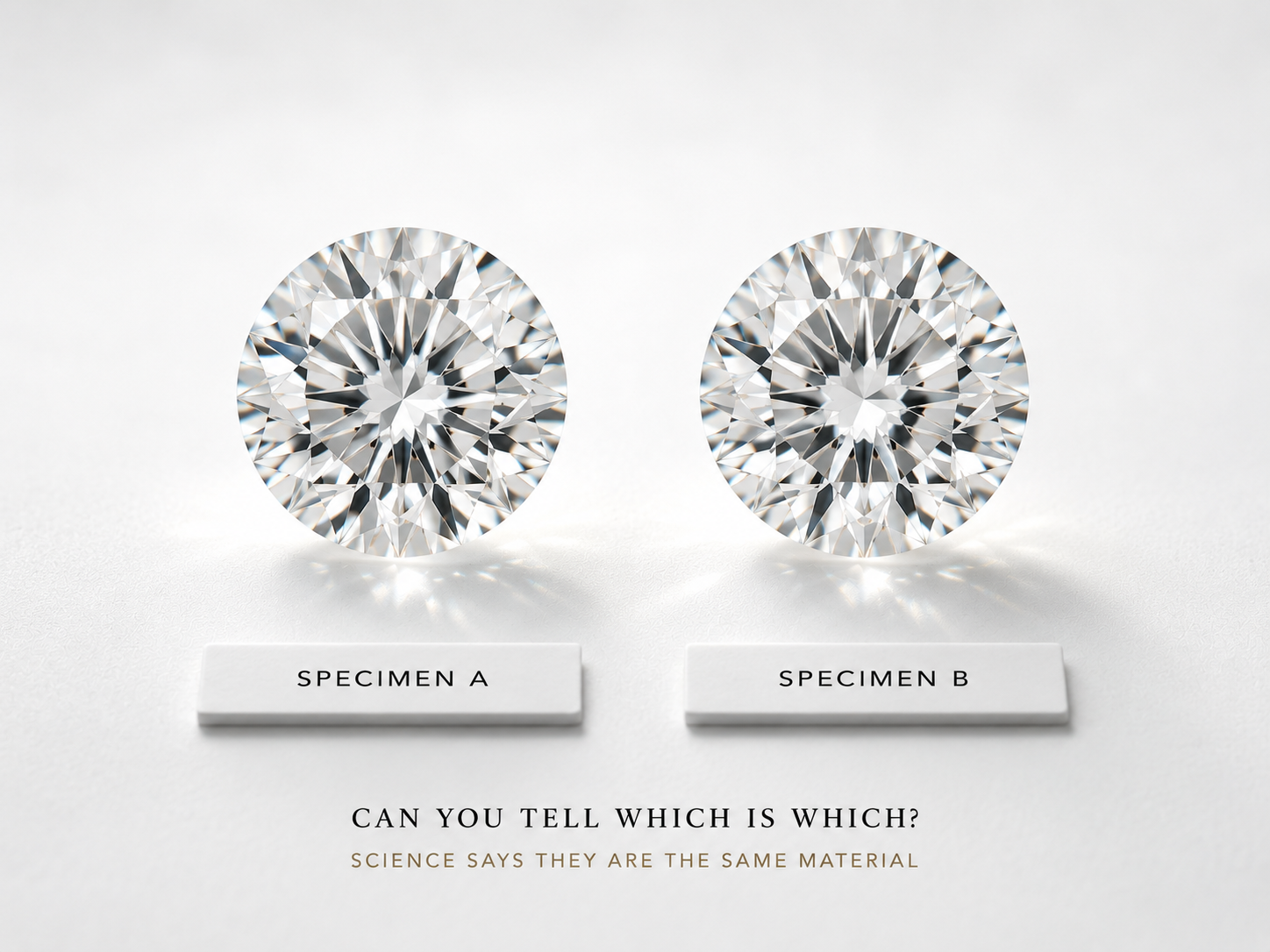
Here is what the evidence shows, organized around the questions that matter most: what these materials are made of, how hard and durable they really are, how they perform over time, and where the genuine differences lie.
What a Diamond Actually Is — Chemically Speaking
A diamond is pure carbon. Not carbon mixed with other elements, not carbon in a loose arrangement — pure carbon atoms bonded together in a specific three-dimensional structure called a cubic crystal lattice. Each carbon atom in that lattice bonds to exactly four neighboring carbon atoms in a tetrahedral arrangement, forming what chemists describe as sp³ hybridized covalent bonds. These bonds are among the strongest in nature.
This structure — and nothing else — is what makes diamond diamond. It is what gives the material its extraordinary hardness, its optical properties, its thermal conductivity, and its chemical stability. The structure is the substance.
A lab-grown diamond has this exact same structure. The same chemical formula (pure carbon), the same cubic crystal lattice, the same tetrahedral bonding geometry. This is not a marketing claim — it is a statement of chemistry that can be verified with X-ray diffraction, spectroscopy, and other analytical techniques. Gemological institutions including the GIA and IGI classify lab-grown diamonds as diamonds precisely because they meet every structural and chemical criterion the term requires.
The word “synthetic,” which sometimes appears on grading reports, is a gemological term of art. In gemology, synthetic means “man-made but chemically and structurally identical to the natural counterpart.” It does not mean fake, simulated, or inferior. A synthetic ruby is a real ruby. A synthetic diamond is a real diamond.
How Lab-Grown Diamonds Are Made
There are two primary methods used to grow diamonds in laboratory conditions, and understanding them helps clarify what “lab-grown” actually means in practice.
High Pressure High Temperature (HPHT) replicates the conditions under which natural diamonds form in the earth’s mantle. A carbon source is subjected to pressures exceeding 1.5 million pounds per square inch and temperatures above 1,400 degrees Celsius. Under these conditions, carbon atoms crystallize around a small diamond seed in the same cubic lattice structure found in natural diamonds. This method has been used since the 1950s and produces diamonds that are chemically indistinguishable from mined stones.
Chemical Vapor Deposition (CVD) takes a different approach. A diamond seed is placed in a chamber filled with carbon-rich gas (typically methane). The gas is ionized into a plasma, causing carbon atoms to deposit layer by layer onto the seed, building up the crystal structure over days or weeks. CVD diamonds are grown at lower pressures than HPHT and are increasingly common in the gem-quality market.
Both methods produce genuine diamonds. The growth method affects the types of inclusions or trace elements a stone may contain — and this is one of the ways gemological labs can identify a diamond’s origin — but it does not change the fundamental material properties.
The Mohs Hardness Scale: What It Measures and Why It Matters
The Mohs hardness scale, developed by German mineralogist Friedrich Mohs in 1812, ranks minerals from 1 (softest) to 10 (hardest) based on their resistance to being scratched. The scale is not linear — the jump from 9 to 10 represents a far greater difference in hardness than the jump from, say, 5 to 6.
Diamond sits at 10. It is the hardest known naturally occurring material on earth. Only another diamond can scratch a diamond’s surface under normal conditions. Materials that commonly come into contact with jewelry — steel tools (around 6.5), quartz dust in household environments (7), even sapphire (9) — cannot scratch a diamond.
Both lab-grown and natural diamonds achieve a Mohs hardness of 10. This is not a rounded figure or an approximation. It is a direct consequence of the sp³ carbon bonding structure they share. Because the atomic structure is identical, the hardness is identical. There is no version of diamond chemistry that produces a Mohs 10 for natural stones and a Mohs 9.5 for lab-grown ones. The hardness is a property of the structure, and the structure is the same.
For practical purposes, this means a lab-grown diamond in an engagement ring will resist scratching from everyday contact — keys, countertops, fabrics, other jewelry — exactly as a natural diamond would.
Lab-Grown Diamonds vs. Diamond Simulants: A Critical Distinction
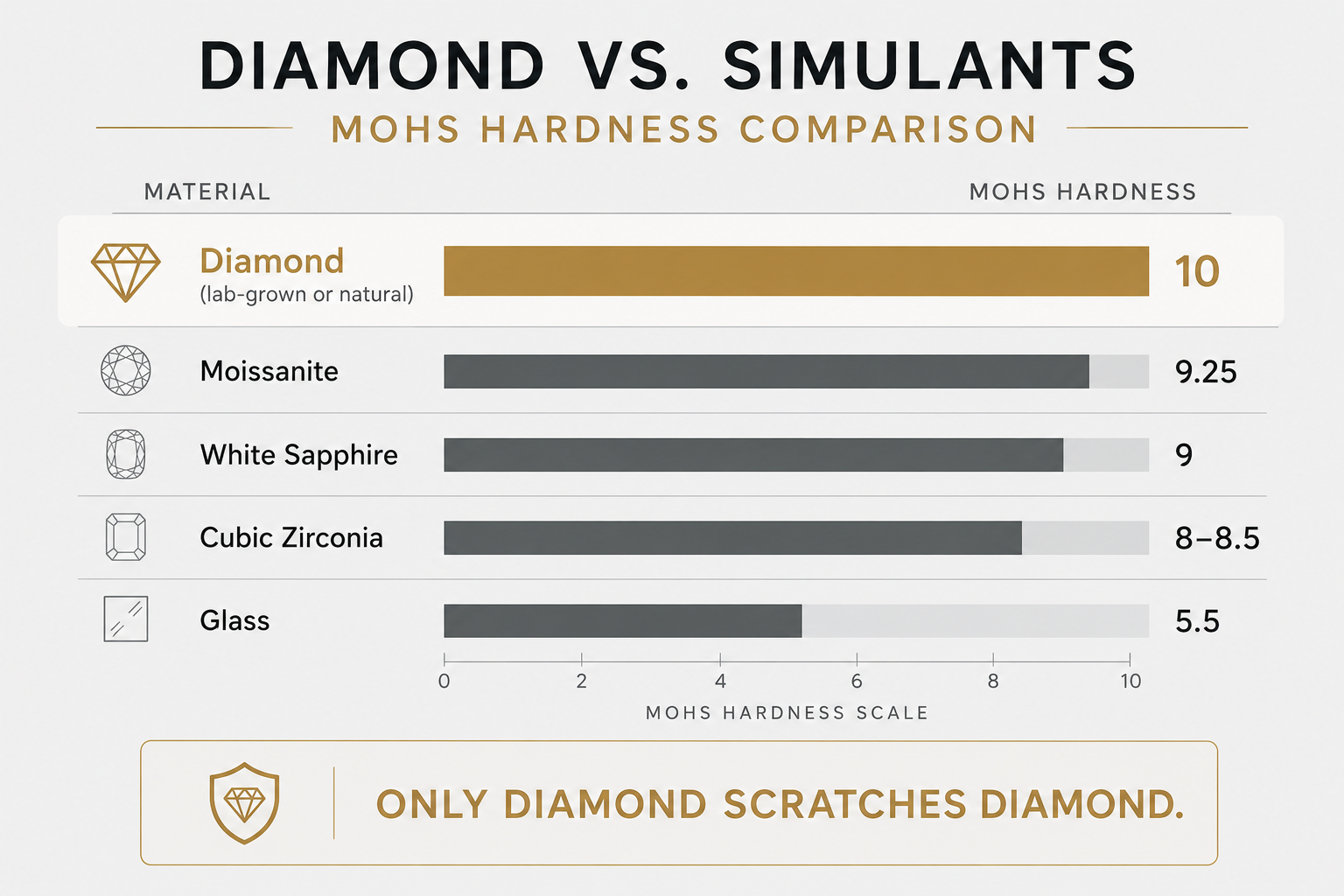
One of the most important clarifications in this space is the difference between a lab-grown diamond and a diamond simulant. These are not the same thing, and the Mohs scale makes the distinction concrete.
- Diamond (lab-grown or natural): Mohs 10. Pure carbon in a cubic crystal lattice.
- Moissanite: Mohs ~9.25. Silicon carbide. Visually similar to diamond but chemically and structurally different.
- Cubic zirconia (CZ): Mohs ~8–8.5. Zirconium dioxide. A common simulant that will scratch and cloud over time with normal wear.
- White sapphire: Mohs 9. Aluminum oxide. Harder than CZ but still softer than diamond.
- Glass: Mohs ~5.5. Scratches easily under normal conditions.
A lab-grown diamond is not a simulant. It is not “like” a diamond or “almost” a diamond. It is a diamond — with the same Mohs 10 hardness, the same chemical composition, and the same optical behavior. The durability gap between a lab-grown diamond and a cubic zirconia is the same as the gap between a natural diamond and a cubic zirconia: enormous.
Hardness vs. Toughness vs. Stability: Three Different Things
A common source of confusion in discussions about diamond durability is the conflation of three distinct material properties. Understanding the difference matters for real-world wear.
Hardness is resistance to scratching. Diamond is Mohs 10 — the best possible rating. Lab-grown and natural diamonds are equal here.
Toughness is resistance to breaking or chipping. This is where diamond’s reputation for invincibility has limits. Despite being the hardest material on earth, diamond has a moderate toughness rating. It has natural cleavage planes — directions along which the crystal structure is relatively weaker — and a sharp blow at the right angle can cause a diamond to chip or fracture. This is true of all diamonds, lab-grown and natural alike. It is a property of the crystal structure, not of the origin.
One nuance worth noting: natural diamonds frequently contain inclusions — internal features like crystals, feathers, or clouds — that formed during their growth in the earth. These inclusions can, in some cases, create localized weak points that affect toughness. Lab-grown diamonds, formed under controlled conditions, often exhibit fewer inclusions, which may contribute to slightly greater structural uniformity in some stones. This is not a categorical advantage of lab-grown over natural — it depends entirely on the individual stone’s clarity grade — but it is a genuine scientific observation.
Stability refers to resistance to chemical, thermal, and environmental change over time. Both lab-grown and natural diamonds are exceptionally stable. They do not react with most household chemicals, do not fade, do not lose hardness, and do not change color under normal conditions. The crystal structure that makes diamond hard also makes it chemically inert under everyday circumstances. A diamond worn daily for fifty years will have the same hardness on the last day as the first.
Optical Properties: Brilliance, Fire, and Scintillation
The visual performance of a diamond — its brilliance (white light reflection), fire (spectral color dispersion), and scintillation (sparkle under movement) — is determined by its refractive index, its dispersion value, and the quality of its cut.
Because lab-grown and natural diamonds share the same crystal structure and chemical composition, they have identical refractive indices and identical dispersion values. Light behaves the same way in both materials. A well-cut lab-grown diamond and a well-cut natural diamond of comparable grades will be visually indistinguishable to the naked eye — and to most trained eyes as well.
The cut is the dominant variable in optical performance. A poorly cut natural diamond will underperform a well-cut lab-grown diamond of the same carat weight, and vice versa. Origin does not determine sparkle. Craftsmanship does.
How Gemological Labs Identify Lab-Grown Diamonds
If lab-grown and natural diamonds are chemically identical, how do institutions like the GIA and IGI tell them apart? The answer lies in subtle differences in growth patterns, trace element profiles, and spectroscopic signatures — none of which are visible to the naked eye or even to a standard loupe.
HPHT diamonds may contain trace amounts of metallic flux inclusions from the growth process. CVD diamonds can show distinctive growth striations and may contain trace amounts of nitrogen or boron in patterns that differ from natural stones. Advanced spectroscopic analysis — infrared spectroscopy, photoluminescence testing, and UV fluorescence — can reveal these signatures.
Importantly, these identification methods require specialized laboratory equipment. A jeweler examining a stone with a loupe cannot reliably identify a lab-grown diamond. Neither can a friend, a family member, or anyone else without access to gemological testing instruments.
Both GIA and IGI grade lab-grown diamonds using the same 4Cs framework — cut, color, clarity, and carat weight — that applies to natural diamonds. The grading standards are identical. The origin is noted separately on the certificate. A lab-grown diamond graded G/VS1 by IGI meets the same criteria for those grades as a natural diamond graded G/VS1.
Where the Real Differences Lie
Having established what is the same, it is worth being precise about what is genuinely different between lab-grown and natural diamonds.
Origin and formation time. Natural diamonds formed over hundreds of millions to billions of years under extreme geological conditions. Lab-grown diamonds form in weeks to months under controlled industrial conditions. This difference is real and factual. Whether it is meaningful to a buyer is a personal question, not a scientific one.
Typical inclusions and trace elements. As described above, the growth environment produces different characteristic inclusions and trace element profiles. These affect how gemologists identify origin, and they affect clarity grades in individual stones — but they do not create a categorical difference in durability or performance between the two types.
Price. Lab-grown diamonds are significantly less expensive than natural diamonds of comparable grades — often 50 to 80 percent less, depending on the market. This reflects differences in supply chain, production cost, and market dynamics, not differences in material quality.
Resale value and market perception. Natural diamonds have historically held resale value better than lab-grown diamonds, whose prices have declined as production has scaled. This is an economic reality, not a scientific one. It reflects supply and demand, not hardness or durability.
Environmental and ethical profile. Lab-grown diamonds avoid the land disruption, water use, and human rights concerns associated with some mining operations. They do require significant energy to produce. The environmental calculus is not simple, but the ethical supply chain of a lab-grown diamond is generally more transparent and traceable.
The Bottom Line
The science is clear. Lab-grown diamonds are real diamonds. They share the same chemical composition, the same crystal structure, the same Mohs 10 hardness, the same optical properties, and the same long-term stability as natural diamonds. They are graded by the same institutions using the same standards. They cannot be distinguished from natural diamonds without specialized laboratory equipment.
The differences that exist — origin, price, resale dynamics, environmental profile — are real and worth understanding. But they are not differences in what the material is or how it performs. They are differences in context, economics, and personal values.
Knowing that distinction is the foundation of a genuinely informed choice.
Frequently Asked Questions
What does ‘synthetic diamond’ mean on a grading report?
In gemology, ‘synthetic’ means man-made but chemically and structurally identical to the natural counterpart. A synthetic diamond is a real diamond — the term does not mean fake or inferior.
What is the difference between HPHT and CVD lab-grown diamonds?
HPHT replicates the high-pressure, high-temperature conditions of the earth’s mantle, while CVD deposits carbon atoms layer by layer from a gas plasma onto a diamond seed. Both methods produce genuine diamonds with identical chemical properties.
Can a jeweler tell a lab-grown diamond from a natural diamond by looking at it?
No. Distinguishing a lab-grown diamond from a natural diamond requires specialized laboratory equipment such as infrared spectroscopy or photoluminescence testing — it cannot be done with a loupe or the naked eye.
Is a lab-grown diamond harder than moissanite or cubic zirconia?
Yes. Lab-grown diamonds score Mohs 10, while moissanite scores approximately 9.25 and cubic zirconia scores 8–8.5. The durability gap between a lab-grown diamond and these simulants is the same as between a natural diamond and those simulants.
Do lab-grown diamonds lose their sparkle over time?
No. The crystal structure that gives diamond its optical properties is chemically stable and does not degrade under normal conditions. A lab-grown diamond will have the same brilliance after decades of wear as on the day it was purchased.


